From blocked DPF filters to faulty injectors — what to check before a small problem becomes a major bill.
A diesel car can be an economical choice for regular longer journeys, but choosing the right vehicle means looking beyond fuel consumption and purchase price.
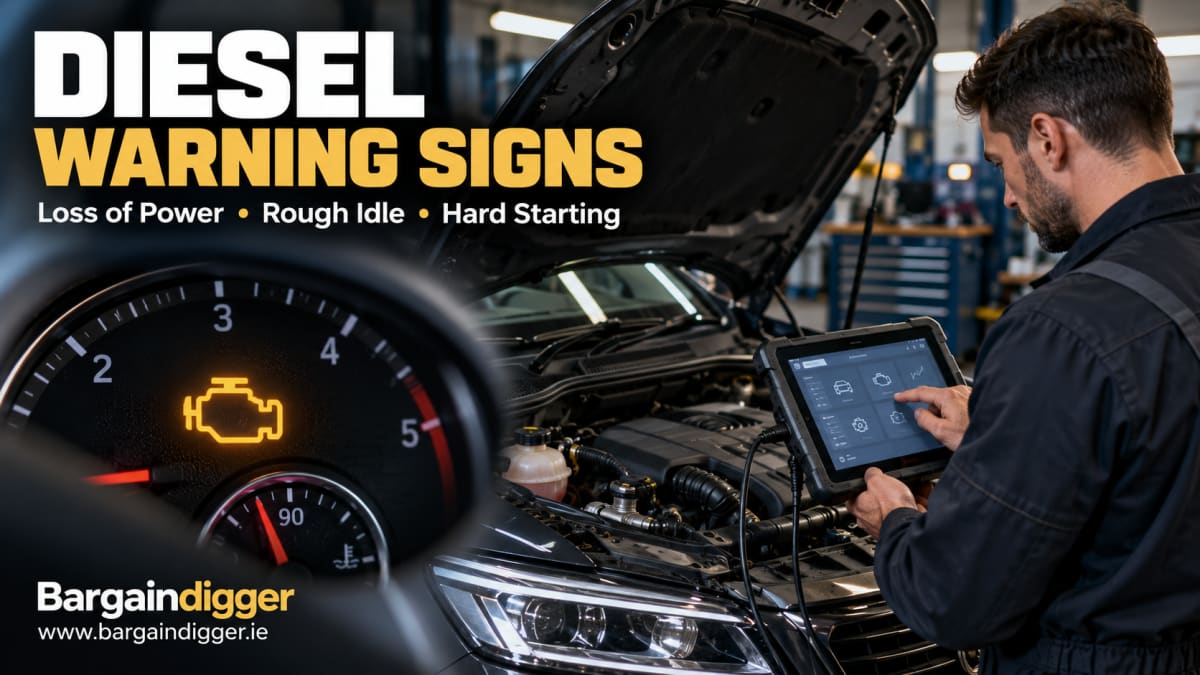
Warning lights, difficult starting, unusual smoke and sluggish acceleration can point to problems with the engine, fuel system or emissions equipment. Recognising these symptoms early can help you make a better buying decision and avoid replacing expensive components unnecessarily.
Whether you already own a diesel or are browsing "used cars for sale in Ireland on Bargaindigger" (https://www.bargaindigger.ie/), here are some of the main problems to understand.
Diesel Car Repair Costs in Ireland: A Quick Guide
The figures below are indicative budgeting ranges, rather than fixed quotations. Prices vary by engine, access, parts quality and garage. Ask whether a quotation includes VAT, diagnostics, labour, coding and any additional components.
DPF prices reflect published Irish workshop and specialist guidance. Other fitted repair ranges are broad editorial estimates; an inspection is needed to establish the actual cost.
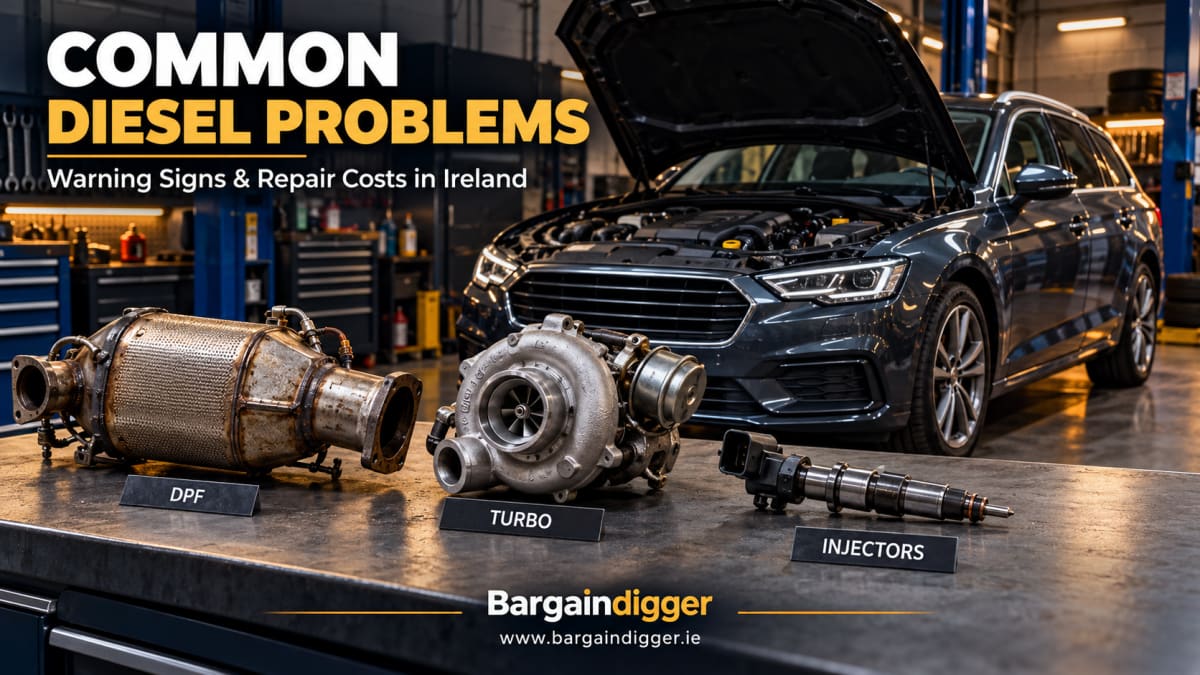
Problem or repair| Indicative budget Initial diagnostic assessment| €60–€120 Workshop DPF regeneration or in-situ treatment| €150–€300 Professional DPF cleaning| €250–€700 DPF replacement| €1,000–€3,000+ EGR cleaning, where suitable| €150–€350 EGR valve replacement| €350–€900+ Diesel injector replacement, per injector| €300–€750+ Turbo boost hose repair or replacement| €120–€350 Turbo replacement using a reconditioned unit| €900–€1,800+ Turbo replacement using a new unit| €1,500–€3,000+ Conventional glow plug set replacement| €150–€400+
Irish specialists advertise DPF cleaning across different price levels because the services differ. A chemical treatment followed by regeneration is not the same job as removing the filter for specialist cleaning. Published Irish DPF guidance places cleaning around €250–€700 and replacement around €1,000–€3,000 or more.
Blocked DPF: Warning Lights and Reduced Power
The diesel particulate filter, usually called the DPF, captures soot from the exhaust. The vehicle periodically burns off accumulated soot through a process called regeneration.
Repeated short journeys can interrupt this process. Other faults, including fuel-system or EGR problems, can also interfere with regeneration or increase soot production.
What might you notice?
- A DPF warning light or engine warning message.
- Reduced acceleration or limp mode.
- Increasing fuel consumption.
- Repeated regeneration attempts.
A higher idle speed, cooling fans running and a hot exhaust smell can occur during normal regeneration. These signs alone do not prove that the filter is blocked.
DPF regeneration, cleaning or replacement?
These are three different approaches:
Regeneration burns off soot when the filter and vehicle are in a suitable condition.
Professional cleaning can remove deposits, including accumulated ash that regeneration cannot burn away. Ask whether the quotation includes removal, refitting and testing.
Replacement may be necessary if the filter is cracked, melted or otherwise beyond recovery. Cleaning cannot repair physical damage.
Example
A diesel hatchback used mainly for school runs develops a DPF warning. The owner assumes it needs a new filter.
An assessment may show that the existing filter can be recovered through an appropriate treatment. However, the garage should also check why regeneration failed. Paying for cleaning without addressing the cause can lead to another warning.
Follow the vehicle handbook when a DPF warning appears. Do not assume that a motorway drive will clear every blockage, particularly if the car has lost power or displays additional warnings.
EGR Valve Problems: Rough Idling and Hesitation
The exhaust gas recirculation valve, or EGR valve, helps control emissions. Deposits can restrict its operation, while electrical or mechanical failures can prevent it from working correctly.
A valve stuck open can cause rough idling, poor acceleration and reduced engine power. An engine warning light may also appear.
What should you look for?
Pay attention to hesitation when pulling away, an uneven idle and a noticeable lack of response during normal acceleration.
These symptoms overlap with injector, airflow and boost problems, so they should prompt diagnosis rather than an automatic EGR replacement.
Repair costs
Allow approximately €150–€350 for cleaning, where appropriate, or €350–€900+ for replacement as a budgeting estimate. Difficult access or work involving the EGR cooler can increase the bill.
Example
A used diesel saloon feels hesitant at low speeds and idles unevenly. Cleaning may help if deposits are preventing the valve from moving properly. It will not repair a failed actuator or damaged electronics.
Faulty Diesel Injectors: Difficult Starting and Uneven Running
Diesel injectors deliver precisely controlled quantities of fuel. When an injector is not working correctly, the engine may struggle to run smoothly.
Possible symptoms include:
- Rough idling or misfires.
- Poor acceleration.
- Increased fuel consumption.
- Unusual knocking.
- Excessive exhaust smoke.
Modern emissions equipment can make visible smoke less obvious, so a clean-looking exhaust does not rule out an injector problem.
How much does injector replacement cost?
Budget roughly €300–€750+ per injector fitted, depending on the vehicle and whether a suitable new or reconditioned unit is used.
For context, one Irish diesel specialist lists selected reconditioned injectors from €175–€230 plus VAT, with selected new units from €250–€350 plus VAT. These are component prices, not complete fitted bills.
Testing, seals, coding and removal labour can add to the total. Seized injectors are particularly difficult to price before work begins.
Example
A four-cylinder diesel shakes at idle and starts poorly. That does not automatically mean all four injectors need replacing. Testing should establish which components are faulty and whether another fuel-system problem is involved.
Turbo and Boost Problems: Sluggish Acceleration or Unusual Noise
A diesel that suddenly feels slow does not necessarily need a replacement turbocharger.
Turbo manufacturer Garrett advises checking the wider system first: poor performance, smoke or excessive oil consumption can also result from injection faults, restricted airflow, exhaust problems or lubrication issues.
Warning signs
Look for a significant loss of pulling power, an unfamiliar whistle or siren-like noise, increased oil consumption or unusual smoke.
Repair costs
A split boost hose may cost approximately €120–€350 to repair or replace.
A larger job involving a reconditioned turbo may require €900–€1,800+, while a new-unit replacement can reach €1,500–€3,000+. These are planning estimates, and complex installations can cost more.
Irish turbo specialists emphasise that the exact engine, unit specification and choice between repair, exchange and new parts determine the quotation.
Example
A diesel SUV loses power and makes a hissing noise under acceleration. A leaking hose or connection should be investigated before an expensive turbo is ordered.
If turbo damage is confirmed, the underlying cause must also be addressed to protect the replacement.
Glow Plug Problems: Trouble Starting on Cold Mornings
Glow plugs help a diesel engine achieve suitable combustion conditions when starting, particularly in cold weather.
Faulty glow plugs can cause difficult starting, rough running after startup, misfires and abnormal exhaust smoke.
Repair costs
For an accessible engine using conventional glow plugs, allow approximately €150–€400+ for a replacement set.
Specialised plugs, control-module faults or seized components can make the repair more expensive.
Example
A diesel estate starts easily when warm but struggles first thing in the morning. The glow plug system is worth checking, alongside the battery, cranking performance and fuel supply. Difficult starting alone does not identify the failed part.
AdBlue and SCR Faults: A Warning That Needs Attention
Many newer diesels use AdBlue and selective catalytic reduction, or SCR, to reduce nitrogen oxide emissions.
A dashboard warning may simply indicate a low fluid level. Other causes can include dosing faults, sensors, leaks or problems elsewhere in the SCR system.
What should you watch for?
- An AdBlue warning that remains after a correct refill.
- An emissions-system fault message.
- A countdown stating that starting will become impossible.
On relevant Volkswagen models, ignoring low-AdBlue warnings can eventually prevent the engine restarting after it is switched off. Always follow the instructions for the particular vehicle.
Why diagnosis matters
An AdBlue refill, a sensor replacement and a tank or pump assembly are very different expenses. A single repair price would be misleading.
Ask for a written diagnosis and an itemised quotation before authorising replacement parts. AdBlue belongs in its separate tank, never in the diesel fuel tank.
What to Check Before Buying a Used Diesel Car
A careful inspection can reveal warning signs before you commit to a purchase.
Start with a genuinely cold engine
Ask the seller to leave the engine cold before your visit. Observe how readily it starts and how smoothly it runs.
Review the service history
Look for invoices showing regular servicing and the correct manufacturer-approved oil. If the DPF, injectors or turbo have been repaired, ask what caused the fault and what work was completed.
Take a proper test drive
Assess the car during normal driving, including acceleration and a warm idle. Watch for warning messages, hesitation, unusual noises and reduced power.
Arrange an independent inspection
A diagnostic scan is useful, but it should accompany a mechanical inspection. Fault codes identify areas requiring investigation; they do not always identify the component that needs replacing.
Match the car to your journeys
If most trips are short and the engine rarely reaches normal operating temperature, consider whether a petrol or hybrid vehicle would suit your use better. Regular interrupted regeneration is a recognised difficulty for DPF-equipped diesels.
Frequently Asked Questions
How much does DPF cleaning cost in Ireland?
Published specialist guidance suggests approximately €250–€700, depending on the vehicle and service. Check whether removal, refitting, diagnostics and VAT are included.
Is DPF cleaning cheaper than replacement?
Usually, when the filter is suitable for cleaning. Replacement can cost around €1,000–€3,000+, but a damaged filter may require replacement regardless of the price difference.
Does a DPF warning mean the filter needs replacing?
No. The vehicle needs assessment to establish the filter’s condition and why the warning appeared. Regeneration or cleaning may be appropriate in some cases.
Is a high-mileage diesel always a bad purchase?
Mileage is only part of the picture. Service records, condition, previous use and an independent inspection provide a more useful basis for a buying decision than the odometer alone.
Can a diesel car still be a good choice in Ireland?
Yes, when its condition and running costs suit the buyer’s needs. The key is choosing a vehicle that matches your journeys and checking its history before buying.
Find Your Next Used Car on Bargaindigger
Understanding common diesel problems makes it easier to ask the right questions, compare vehicles and budget for ownership.
Explore "used cars for sale in Ireland on Bargaindigger" (https://www.bargaindigger.ie/), compare available listings and ask sellers about servicing, previous repairs and independent inspections before making your decision.
Price guide checked in October 2026. Figures are indicative and may change; obtain a vehicle-specific written quotation.